

Find Meltric Plugs with Spring-Assisted Terminals
Many factors can contribute to the loosening of terminal screws. These include:
- Rough handling that frequently occurs in routine use
- Vibration due to nearby and/or connected equipment
- Thermal cycling due to the intermittent current passage
- The settling and yielding of multi-strand conductor that occurs after tightening
- The normal yielding of solid copper conductors that results from the pressure of the terminal screw
Simple terminal screws, as are used on many competitive devices, cannot overcome all of these potential problems. In fact, the unintended loosening of terminal screws is one of the main causes of failure for standard plugs and receptacles.
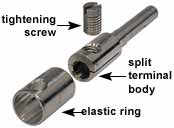
Meltric has solved this problem with its patented spring-assisted terminals.
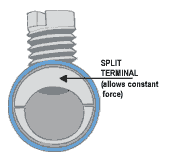
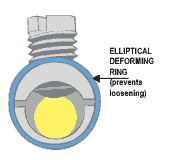
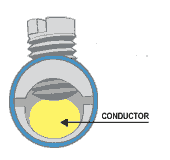
Meltric's unique design uses a split terminal body that is surrounded by a spring ring to ensure that a constant force is applied to the conductor. The pressure generated as the screw is tightened against the conductor causes the split terminal body to open. In-turn, this causes the spring ring surrounding the terminal body to elastically deform into an elliptical shape.
The natural tendency of the ring to want to spring back to its original shape maintains the screw pressure against the conductor and effectively compensates for the loosening effects of conductor yield, thermal cycling, vibration and rough handling.
In addition, several other features were also incorporated into the design to further improve the integrity of the connection:
- The diameter of the screw head is similar in size to the threaded hole. This helps ensure that the conductor can be securely captivated.
- The split terminal body has an offset design to maximize the number of threads engaged on the screw.
Together, these features contribute to making a lasting (but reusable) connection that does not have to be checked regularly. The user can tighten it and forget it.